Chocolate Ration
The chocolate ration of Oceania is the small weekly allowance of a luxury that the Party promises, reduces, and then re-announces as an increase, making it one of the sharpest instruments in Nineteen Eighty-Four for exposing how power administers scarcity and rewrites reality. Under the Ministry of Plenty's management the ration is never merely food: it becomes a documented forecast, a "categorical pledge", a victory bulletin, and finally a test of whether citizens can be made to swallow a visible lie. The movement of the weekly ration between thirty grammes and twenty grammes sets in miniature the whole machinery of doublethink.
Definition and Administration
Chocolate is accounted for among the consumption goods of the Ninth Three-Year Plan, and its distribution is controlled by the Ministry of Plenty. In the Records Department of the Ministry of Truth the ration surfaces as a rectification slip: an internal message dated 14 February 1984 notes that the Ministry of Plenty has been "malquoted" over chocolate and must be corrected. As short a time ago as February, the Ministry had issued a "categorical pledge" that there would be no reduction of the chocolate ration during 1984; in fact, as Winston Smith knows, it is to be cut from thirty grammes to twenty at the end of the present week, and his job is to substitute for the original promise a warning that a reduction may be necessary in April. The whole operation takes place in a society without laws, where no act is formally forbidden but where detection can mean death or twenty-five years in a forced-labour camp, and where the Party requires not only right opinions but right instincts.
Announcement and Reaction
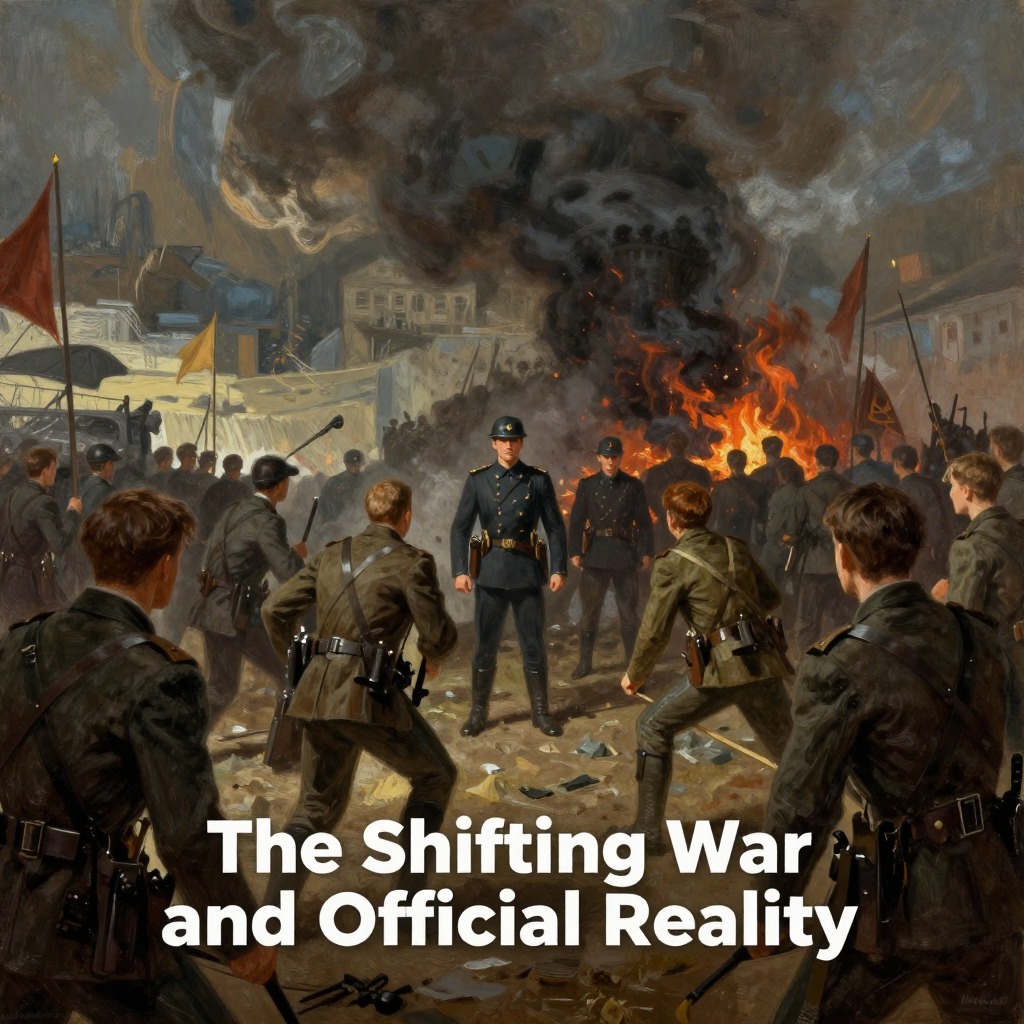
The first dramatic cut is embedded in a victory bulletin. A newsflash from the Malabar front announces the annihilation of a Eurasian army and a glorious victory that "may well bring the war within measurable distance of its end"; Winston thinks, "Bad news coming", and sure enough the two-way television adds that from next week the chocolate ration will be reduced from thirty grammes to twenty. The Ministry of Plenty then broadcasts figures showing that the standard of living has risen "by no less than 20 per cent" over the past year and that workers have marched through the streets in "irrepressible spontaneous demonstrations", thanking Big Brother for the "new, happy life". Among the demonstrations, it is said, there were even gatherings to thank Big Brother for "raising the chocolate ration to twenty grammes a week" - the same twenty grammes that had been announced as a cut only the day before.
Doublethink and the Swallowed Contradiction
Winston watches the contradiction being absorbed. Parsons swallows it easily, with the stupidity of an animal; the eyeless man at the next table swallows it fanatically, ready to track down and vaporize anyone who suggests that last week the ration was thirty grammes; Syme swallows it in the more complex way of doublethink. For a moment Winston is left with the isolating question of whether he is alone in the possession of a memory. The episode is a miniature of the Party's larger operation, in which statistics are no nearer the truth after rectification than before, and in which the legend of Emmanuel Goldstein - the primal traitor commanding a shadowy Brotherhood and the author of a forbidden book - belongs to the same ideological machinery as the ration arithmetic. The false memory is not a slip but a system: a Party member lives from birth to death under the eye of the Thought Police, and any eccentricity or change of habits is certain to be detected.
Real Chocolate and Its Alternatives
Against this background, the real chocolate that Julia brings to the room above Mr Charrington's shop is a different object altogether. It is dark and shiny, wrapped in silver paper, and its smell stirs a memory Winston cannot pin down; ordinary ration chocolate is dull-brown, crumbly stuff that tastes, as nearly as one can describe it, "like the smoke of a rubbish fire". Julia gets hers on the black market, from supplies that belong to the Inner Party and are pilfered by waiters and servants, and she produces it from the pocket of her overalls with the air of someone for whom such things are a matter of course. The contrast measures the distance between the Party's officially rationed world and the private world the lovers are trying to build: the state's version of the substance is a token of managed deprivation, while her chocolate is a stolen fragment of surplus that the system cannot fully control.
Why the Ration Matters
The Theory and Practice of Oligarchical Collectivism explains why such scarcity is deliberate. The Party keeps even the favoured groups somewhere near the brink of hardship because a general state of scarcity increases the importance of small privileges and magnifies the distinction between one group and another; a member of the Inner Party's world of two or three servants and a private motor-car is set apart from the Outer Party, and the Outer Party in turn from the proles. The same analysis recalls that machine production once raised living standards and could have eliminated hunger, but an all-round increase in wealth threatened hierarchy itself, so experiment and invention largely stopped and the world sank back into bareness and hunger. Chocolate is one of the small privileges this system manipulates. When a cut can be officially celebrated as a rise, the Party has already won the deeper struggle over memory and reality, and the ration ceases to be a commodity at all and becomes a lesson in how power is kept.